
PUBLIC LIABILITY CLAIMS
If you were injured in a public place because someone failed to keep it reasonably safe, you may be able to claim compensation. That covers shops, pavements, restaurants, car parks, leisure centres and public services — anywhere the person responsible owed you a duty of care.
Injuries Direct is a specialist personal injury team acting for people across England and Wales on a no win, no fee basis. We're a trading style of NJS Law Limited, regulated by the Solicitors Regulation Authority.
FIND OUT IF YOU HAVE A CLAIM
FIND OUT IF YOU HAVE A CLAIM
— WHAT IS A PUBLIC LIABILITY CLAIM?
A public liability claim is a compensation claim brought when you're injured in a public place because the person or organisation responsible for that place failed to take reasonable care to keep it safe.
The legal basis is a duty of care. Shops owe one to their customers. Councils owe one to people using their pavements and roads. Restaurants, gyms, car park operators, salons and transport providers all owe one to the people who use them.
Critically, that duty is to take reasonable care — not to guarantee that nothing can ever go wrong. A claim doesn't succeed simply because you were hurt. It succeeds where the organisation responsible fell short of what could reasonably have been expected of them, and you were injured as a result.
Two questions usually decide these claims:
Should they have known about the hazard? A spillage that's been on a supermarket floor for an hour is very different from one that happened thirty seconds earlier.
Did they have a reasonable system in place? Regular inspections, prompt cleaning, warning signs. Where a system existed and was followed, a claim is harder. Where it didn't, or wasn't, it's considerably stronger.
— COULD YOU BE ENTITLED TO COMPENSATION?
You may be able to claim if all three of the following apply:
Someone owed you a duty of care — the occupier of the premises, the highway authority, the business providing the service.
They fell short of that duty — a hazard went unaddressed, a known defect went unrepaired, no warning was given.
You were injured as a result — and the injury was caused by their failure, not by something unrelated.
— HOW LONG DO YOU HAVE TO MAKE A PUBLIC LIABILITY CLAIM?
In most public liability claims in England and Wales, you usually have three years from the accident date to start a claim. If the injury was not obvious straight away, the time limit may run from the date you became aware of it.
There are exceptions, including claims involving children, people who lack mental capacity, delayed symptoms, or fatal accidents.
Even though three years may sound like a long time, it is best to act quickly. CCTV, accident reports, cleaning records and witness evidence can disappear within weeks.
— HOW MUCH COMPENSATION CAN I CLAIM?
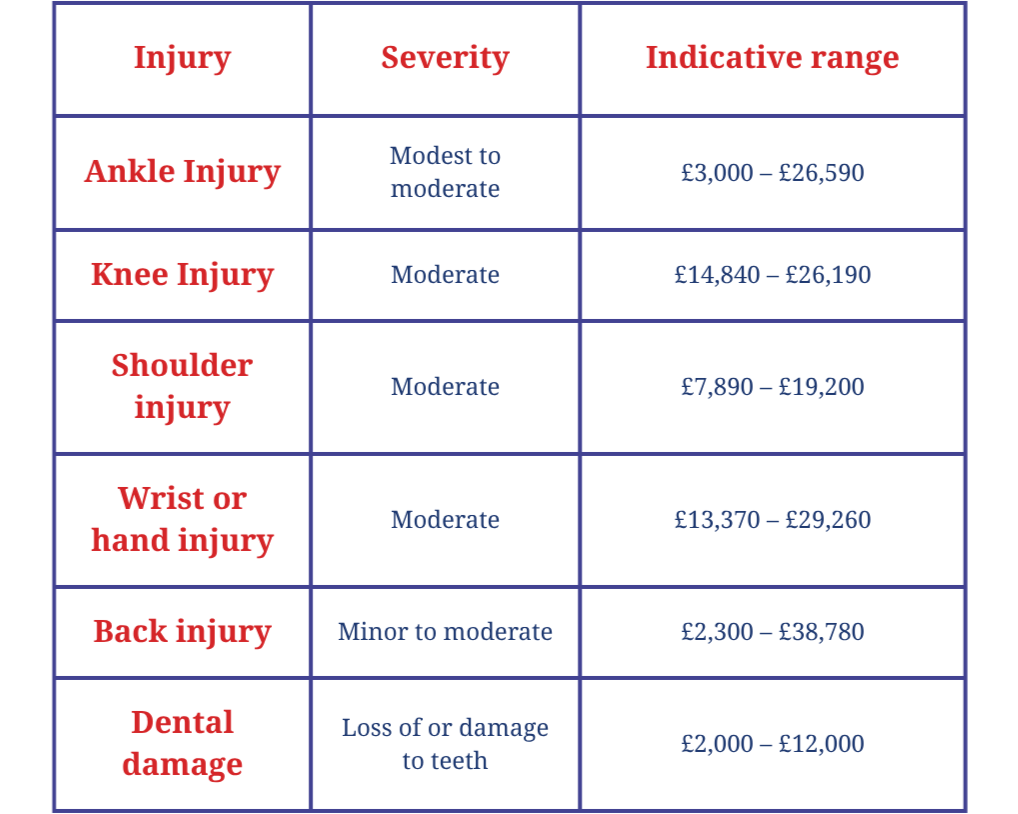
There's no fixed amount. Compensation depends on the severity of your injury, how long it affects you, and the financial losses it causes.
Claims are made up of two parts:
General damages — compensation for the injury itself: the pain, the recovery, and the impact on your day-to-day life. Solicitors and courts value this by reference to the Judicial College Guidelines, published bands based on injury type and severity, supported by medical evidence.
Special damages — the financial cost of the accident. Lost earnings, prescription charges, private treatment, travel to medical appointments, care provided by family, damaged clothing or possessions. This is the part people most often forget to claim, because nobody keeps a receipt for a taxi to hospital.
— REAL RESULTS FROM OUR TEAM
£25,000 — a client fractured a toe and injured both hands after becoming entangled in cling film trailing from a pallet in a supermarket, and was off work for months.
£6,000 — a client slipped on spilled washing-up liquid in a supermarket, with the fall also triggering a rheumatoid arthritis flare-up.
£9,000 — a client tripped on raised bathroom flooring that had been reported to the council roughly a year earlier and never repaired.
— TYPES OF PUBLIC LIABILITY CLAIMS WE HANDLE
— SUPERMARKET AND SHOP ACCIDENTS
Retailers must have a reasonable system for spotting and clearing hazards during trading hours. Spillages, trailing packaging, stock left in walkways and unmarked wet floors are among the most common causes of injury in shops.
— PAVEMENT AND HIGHWAY TRIPS
Highway authorities must maintain public roads and footpaths. If they miss a significant defect, you may be able to claim — but early evidence is key.
— POTHOLES AND POORLY MAINTAINED SURFACES
Uneven paving, raised tarmac, potholes concealed under standing water. These cause serious injuries — we've acted in a case where a child broke their arm on raised tarmac in a local park.
— RESTAURANTS, PUBS AND LEISRUE VENUES
Anywhere open to the public owes its visitors a duty of care — including keeping floors safe, lighting adequate and equipment maintained.
— FAULTY AND CONTAMINATED PRODUCTS
Manufacturers and retailers have a duty to ensure what they sell is safe. We've acted for a client who chipped a tooth on a piece of wire embedded in a biscuit.
— BEAUTY AND COSMETIC TREATMENT INJURIES
Salons are expected to follow standard safety practice, including patch testing before treatments known to cause reactions. Where that's skipped and injury follows, a claim may arise.
— INJURIES CAUSED BY ANOTHER PERSON’S ACTIONS
Where you've been hurt by someone's deliberate act, a claim may be possible against them, against an organisation that failed to keep you safe, or through the Criminal Injuries Compensation Authority
— HOW DO I MAKE A PUBLIC LIABILITY CLAIM?
1
Your free initial call Tell us what happened. We'll ask about the circumstances, your injuries and any losses so far, and tell you whether we think you have a claim. There's no charge and no obligation to go further.
2
Setting up your claim If you decide to proceed, we'll set up a no win, no fee agreement — a Conditional Fee Agreement. We'll explain the success fee and everything you're signing before you commit to anything.
3
Investigating and establishing liability We notify the organisation responsible and gather the evidence: photographs, witness accounts, CCTV, accident book entries, inspection and cleaning records. This is the stage where acting quickly matters most, because much of that evidence has a short shelf life.
4
Medical evidence and valuing your claim You'll be examined by an independent medical expert who reports on your injuries and your recovery. Tell them about every symptom — the report is difficult to change later. We combine that with a schedule of your financial losses to value the claim properly.
5
Negotiation and settlement We negotiate with the other side's insurers. Most claims settle without a court hearing. Where proceedings are necessary, we'll explain exactly what that involves and what it means for you.
— REAL RESULTS
£25,000
Trapped in cling film at a supermarket — Our client fell over cling film trailing from a pallet on the shop floor, fracturing a toe and injuring both hands. They were off work for months.
£6,000
A slip that worsened an existing condition — A supermarket spillage caused knee and elbow injuries and triggered a rheumatoid arthritis flare-up. We made sure the aggravation counted.
£20,500
A child's broken arm on raised tarmac — Our client's child tripped on poorly maintained tarmac in a local park and broke their arm. We brought the claim on the child's behalf.
£4,000
A piece of wire in a biscuit — Our client chipped a tooth on a small piece of wire embedded in the product. Food sold to the public has to be safe to eat. [Read the full case study
£6,000
A defect that had already been reported — Our client tripped on loose bathroom flooring, injuring a shoulder and leg. It had been reported to the council a year earlier and never repaired.
£3,500
A broken foot on an uneven pavement — Our client tripped near ongoing maintenance work and broke their foot in two places. Footpaths should be kept safe, especially around works.
— WHY CHOOSE US?
We act for injured people, never for insurers. Our work is entirely on the claimant side. There's no divided loyalty and no other client whose interests sit against yours.
No win, no fee, explained upfront. If your claim doesn't succeed, you don't pay us for our work. If it does, the success fee is capped and agreed with you in writing before anything starts. Ask us what it is — you should ask every firm that.
A specialist personal injury team. Our team includes solicitors and litigation executives who handle employers' and public liability claims day in, day out.
Regulated by the Solicitors Regulation Authority. Injuries Direct is a trading style of NJS Law Limited, SRA number 8006550. That regulation brings obligations to you — including a complaints procedure and the right to escalate to the Legal Ombudsman.
Honest about what we can and can't do. If we don't think you have a claim, we'll tell you at the first call rather than after three months.
— WHAT DOES NO WIN, NO FEE MEAN?
"No win, no fee" is the everyday name for a Conditional Fee Agreement. Our fee is conditional on the outcome of your claim.
If your claim succeeds: a success fee is deducted from your compensation. In personal injury cases there's a legal cap on how much of your damages it can come from, and the percentage is agreed with you in writing before your claim begins.
If your claim doesn't succeed: you don't pay us for our work.
Protection against the other side's costs: we'll explain how you're protected from the opponent's legal costs, including any insurance arrangement, before you sign anything.
No hidden deductions and no surprises at the end. If anything in your agreement isn't clear, ask us — we'd rather explain it twice.
— FAQ
Frequently asked questions
Common questions about Public Liability claims, and our answers.
-
You may be able to, if the shop failed to take reasonable care to keep the floor safe. A key question is usually how long the hazard was there and whether the store had a proper system for checking and cleaning. CCTV and cleaning records often decide these claims — which is why getting advice early matters.
-
Possibly. Highway authorities have a duty to maintain public footpaths, but they can defend a claim by showing they had a reasonable system of inspection and repair. Whether a defect was significant enough to have been picked up is central. Photographs with something for scale, taken as soon as possible, are extremely useful.
-
It doesn't necessarily prevent a claim, though it can make it harder to prove. If you can still report it, do. If you can't, we'll work with the evidence available — medical records, witnesses, photographs.
-
Yes. You can't claim for a condition you already had, but you can claim for the extent to which the accident made it worse. Insurers often argue symptoms would have occurred anyway, and answering that takes proper medical evidence.
-
Most personal injury claims in England and Wales settle by negotiation without a court hearing. Even where proceedings are issued, that's frequently a procedural step rather than a sign you'll be giving evidence.
-
Nothing upfront. We act on a no win, no fee basis: if the claim doesn't succeed you don't pay us for our work, and if it does, the success fee is capped and agreed with you in advance.
-
It depends on the complexity and whether liability is admitted. Straightforward claims can conclude in months. More serious ones take longer — and rushing to settle before the medical picture is clear rarely works in your favour.
-
Photographs of the hazard with something for scale, the details of any witnesses, a record in the accident book, confirmation of who owns or manages the location, and prompt medical attention so your injuries are documented. Keep receipts for every cost.
-
Yes. A child can't bring their own claim, so a parent or guardian brings it as a litigation friend. Any settlement is reviewed by the court to check it's in the child's best interests, and the compensation is normally held for them until they turn 18.
READY TO FIND OUT IF YOU HAVE A CLAIM?
There's no paperwork to prepare and no pressure. Call us, tell us what happened, and we'll tell you what we think.
If we don't believe you have a claim, we'll say so — at the first call, not after months of work. If we do, we'll explain exactly what happens next and what it costs you.
Call: 0330 818 1202 (Monday to Friday, 9am–5pm)