

OCCUPIERS
LIABILITY
If you were injured because of the condition of a building, its equipment or its floors, you may be able to claim compensation. Whoever controls those premises — a landlord, a business, a transport operator — has a legal duty to take reasonable care to keep visitors safe.
Injuries Direct is a specialist personal injury team acting for people across England and Wales on a no win, no fee basis. We're a trading style of NJS Law Limited, regulated by the Solicitors Regulation Authority.
FIND OUT IF YOU HAVE A CLAIM.
IT TAKES ONE PHONE CALL.
— WHAT IS AN OCCUPIERS’ LIABILITY CLAIM?
An occupiers' liability claim is a compensation claim brought when you're injured because premises weren't kept reasonably safe by whoever controls them.
Unlike most injury claims, this one rests on statute. The Occupiers' Liability Act 1957 sets out the duty owed to lawful visitors: a duty to take such care as is reasonable to see that you're reasonably safe in using the premises for the purpose you're there for. The Occupiers' Liability Act 1984 extends a narrower duty to people who aren't lawful visitors.
"Occupier" doesn't mean owner. It means whoever has sufficient control over the premises — which might be a landlord, a managing agent, a tenant business, or a transport operator. More than one party can be an occupier of the same place at the same time, and part of our job is identifying who's actually responsible.
— COULD YOU BE ENTITLED TO COMPENSATION?
You may be able to claim if all three of the following apply:
Someone occupied or controlled the premises where you were injured.
They failed to take reasonable care to keep it safe — a defect went unrepaired, equipment wasn't maintained, no warning was given.
You were injured as a result of that failure.
NO WIN, NO FEE, FREE CONSULTATION
NO WIN, NO FEE, FREE CONSULTATION
— TIME LIMITS FOR MAKING A CLAIM
In most cases in England and Wales you have three years from the date of the accident. Where an injury wasn't immediately apparent, the three years can run from the date you became aware of it.
Exceptions apply:
Children: the clock doesn't start until their eighteenth birthday, so a claim can usually be brought until they turn 21. [Claiming for a child [LINK → NEW ARTICLE: /claiming-for-a-child]]
Lack of mental capacity: the limitation period may not run while someone lacks capacity to claim.
Delayed onset: the date of knowledge may apply instead of the accident date.
Fatal accidents: different rules apply.
Why waiting costs you more here than in most claims. Occupiers' liability turns heavily on maintenance and inspection records — servicing logs for lifts and equipment, cleaning rotas, gritting schedules, records of previous reports of the same fault. Those documents are exactly what proves an occupier knew about a problem, and they don't stay accessible forever. CCTV is routinely overwritten within weeks.
— HOW MUCH COMPENSATION CAN YOU GET?
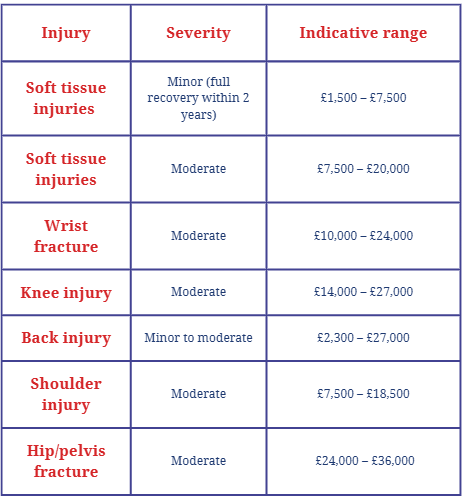
There's no fixed amount. Compensation depends on the severity of your injury, how long it affects you, and the financial losses it causes.
Claims have two parts:
General damages — compensation for the injury itself: pain, recovery, and the effect on your daily life. Valued by reference to the Judicial College Guidelines and supported by medical evidence.
Special damages — the financial cost. Lost earnings, prescriptions, private treatment, travel to appointments, care provided by family, damaged possessions. This is the part people most often forget to claim.
— TYPES OF OCCUPIERS’ LIABILITY CLAIMS WE HANDLE
Faulty Lifts and Building Equipment — Where a fault has occurred before and wasn't fixed, that history becomes central to the claim.
Slips on Wet or Unmarked Floors — Freshly mopped floors need warning signs. Where cleaning takes place with no signage and someone falls, the occupier will struggle to show they took reasonable care.
Untreated Ice and Snow — Occupiers are expected to take reasonable steps to deal with ice on areas people use — car parks, walkways, delivery bays. Gritting records are often decisive.
Gym and Leisure Equipment Failures — Gyms must maintain their equipment and inspect it regularly. When a machine fails mid-use, poor maintenance is frequently the cause.
Accidents on Public Transport Premises — Stations, platforms and carriages are occupied premises. Operators owe passengers a duty to keep them reasonably safe.
Injuries to Delivery Drivers and Contractors — If you're injured while working on someone else's premises, the occupier owes you a duty as well as your employer. You may have a claim against either or both.
TALK TO A SPECIALIST TODAY
— HOW TO MAKE A CLAIM, STEP-BY-STEP
STEP 1 — YOUR FREE INITIAL CALL
Tell us what happened. We'll ask about the premises, your injuries and any losses, and tell you whether we think you have a claim. No charge, no obligation.
STEP 2 — SETTING UP YOUR CLAIM
Tell us what happened. We'll ask about the premises, your injuries and any losses, and tell you whether we think you have a claim. No charge, no obligation.
STEP 3 — ESTABLISHING LIABILITY
We identify who controlled the premises and gather key evidence, such as inspection logs, cleaning rotas and maintenance records.
STEP 4 — MEDICAL EVIDENCE
An independent medical expert assesses your injuries and recovery. We then use this, alongside your financial losses, to value your claim.
STEP 5 — NEGOTIATION AND SETTLEMENT
We negotiate with the insurers. Most claims settle without a court hearing. Where proceedings are needed, we'll explain exactly what that involves.
— WHY CHOOSE INJURIES DIRECT?
We act for injured people, never for insurers. Our work is entirely claimant-side. No divided loyalty. No win, no fee, explained upfront. If your claim doesn't succeed, you don't pay us for our work. If it does, the success fee is capped and agreed with you in writing before anything starts.
We know which records decide these claims. Occupiers' liability cases are frequently won or lost on servicing logs, inspection records and evidence of previous reports. Knowing what to request, and requesting it early, is most of the work. Regulated by the Solicitors Regulation Authority. A trading style of NJS Law Limited, SRA number 8006550.
Honest about what we can and can't do. If we don't think you have a claim, we'll say so at the first call.
— FREQUENTLY ASKED QUESTIONS
-
They overlap. Occupiers' liability is a specific statutory duty owed by whoever controls premises, under the Occupiers' Liability Acts 1957 and 1984. Public liability is the broader term covering injuries to the public generally, including on highways and from products. If your accident was caused by the condition of a building or its equipment, it's likely occupiers' liability.
-
Whoever has sufficient control over the premises, which isn't always the owner. It can be a landlord, a managing agent, or the business operating there — and more than one party can be an occupier at once. Identifying the right defendant is part of what we do.
-
Not automatically. The question is whether the warning was enough to make you reasonably safe in the circumstances. A sign that was too small, badly placed, or put out after the hazard appeared may not be enough.
-
Yes. Occupiers' liability applies to private premises — blocks of flats, private car parks, business premises. One of our results involved a lift collapse in a private block of flats.
-
Yes. If you were injured on someone else's premises while working, the occupier owes you a duty as well as your employer, and you may have a claim against either or both. Two of our results involve delivery drivers.
-
A narrower duty is owed to people who aren't lawful visitors, under the Occupiers' Liability Act 1984. It's harder to establish, but it isn't automatically hopeless — particularly where the occupier knew of a danger and did nothing about it. Take advice rather than assuming.
-
Most personal injury claims in England and Wales settle by negotiation without a court hearing.
-
Photographs of the hazard with something for scale, witness details, an accident book entry, confirmation of who manages the premises, and prompt medical attention. If you know the fault had happened before, say so — that's often the strongest evidence available.
READY TO FIND OUT IF YOU HAVE A CLAIM?
Call 0330 818 1202 or email injuriesdirect@njslaw.co.uk