

PERSONAL INJURY CLAIMS
If you have been injured through no fault of your own, you could be entitled to compensation. At Injuries Direct, we specialise in personal injury claims across England and Wales — and we handle every case on a No Win, No Fee basis. That means no upfront costs, no hidden fees, and no financial risk to you.
Whether you have been hurt in a road accident, injured at work, slipped on a wet supermarket floor, or been knocked off your bike, our team is here to help you get the compensation you deserve. Find out more about your personal injury claims or call us free today to talk through your situation.
★ ★ ★ ★ ★
Rated Excellent on Google
NO WIN
No Fee ∙ No Hidden Costs
FREE
Initial Assessment, No Obligation
E&W
Claims Across England & Wales
SRA
Authorised & Regulated
What Is a Personal Injury Claim?
A personal injury claim is a legal claim for compensation when you have been physically or psychologically hurt because of someone else’s negligence. “Negligence” simply means that another person or organisation failed to take reasonable care, and that failure caused your injury.
You could have a personal injury claim if you were injured:
In a road traffic accident — as a driver, passenger, cyclist, or pedestrian.
At work — due to unsafe conditions, equipment, or practises.
In a public place — a shop, supermarket, pavement, car park, or leisure facility.
Due to someone else’s dangerous behaviour
The compensation you receive is designed to cover your pain and suffering, any loss of earnings, medical expenses, and the cost of any care or rehabilitation you needed as a result of the injury.
You do not need to pay anything upfront to make a claim. Injuries direct operates on a strict No Win, No Fee basis — if your claim is unsuccessful, you pay nothing.
— CAN I MAKE A PERSONAL INJURY CLAIM?
— YOU MAY QUALIFY IF:
The incident occurred within the last 3 years
You suffered a physical or psychological injury
Someone else’s negligence caused the accident
You were not the sole person responsible
You have medical evidence of your injuries
You incurred financial loss as a result
— TYPES OF PERSONAL INJURY CLAIMS WE HANDLE
We handle a wide range of personal injury claims across England and Wales. Select the type of accident or injury that applies to your situation to find out more.
01 —ACCIDENT AT WORK
We handle a wide range of personal injury claims across England and Wales. Select the type of accident or injury that applies to your situation to find out more.
02 —OCCUPIERS' LIABILITY CLAIMS
We handle a wide range of personal injury claims across England and Wales. Select the type of accident or injury that applies to your situation to find out more.
03 —PUBLIC LIABILITY CLAIMS
We handle a wide range of personal injury claims across England and Wales. Select the type of accident or injury that applies to your situation to find out more.
04 —SUPERMARKET ACCIDENT CLAIMS
We handle a wide range of personal injury claims across England and Wales. Select the type of accident or injury that applies to your situation to find out more.
05 —SLIP, TRIP AND FALL
We handle a wide range of personal injury claims across England and Wales. Select the type of accident or injury that applies to your situation to find out more.
06 —PAVEMENT ACCIDENT
We handle a wide range of personal injury claims across England and Wales. Select the type of accident or injury that applies to your situation to find out more.
HOW TO MAKE A PERSONAL INJURY CLAIM
01
03
05
Free Assessment — Tell Us What Happened
Call us free of cost or complete our quick online form. One of our specialist solicitors will listen to your situation, answer your questions, and give you an honest assessment of whether you have a valid claim — with no obligation to proceed and nothing to pay.
We Build Your Case
If you decide to proceed, we take care of everything. We gather evidence, obtain your medical records. commission independent medical reports if required and identify who is responsible for your injury. You do not need to deal with insurers yourself at any point.
We Contact the Other Side
We formally notify the negligent party (or their insurer) of your claim and the basis on which we are seeking compensation. They have a set period to investigate and respond. We handle all correspondence on your behalf.
Negotiation and Settlement
The majority of personal injury claims settle out of court through negotiation. We will advise you on any offer made and negotiate hard on your behalf to ensure you receive the maximum compensation you are entitled to. We never recommend you accept a settlement that undervalues your claim.
You Receive Your Compensation
Once a settlement is agreed (for awarded by the court), the compensation is paid to you directly. On a No Win, No Fee basis, a success fee is deducted from your compensation — capped at 25% of your general damages. We will explain this clearly before you sign anything.
02
04
— WHAT IS NO WIN, NO FEE?
No Win, No Fee (formally known as a Conditional Fee Agreement) means that you only play your solicitor’s fees if your claim is successful. If your case does not succeed, you pay nothing at all.
If your claim wins, a success fee is deducted from your compensation. By law, this success fee is capped at 25% of your general damages (the amount you receive for your pain and suffering). We will explain exactly what this means for your specific case before you agree to anything — there are no surprises.
In most cases, the defendant (the person or organisation at fault) also pays a significant portion of your legal costs. This means the overall deduction from your compensation is usually lower than the maximum 25%.
— HOW MUCH COMPENSATION COULD I RECEIVE?
Compensation for a personal injury claim is made up of two parts:
General damages — for the pain, suffering, and loss of amenity caused by your injury. These figures are set by the Judicial College Guidelines.
Special damages — for your actual financial losses: lost earnings, medical expenses, travel costs, care costs, and any other out-of-pocket expenses caused by the accident.
The table below shows indicative general damages ranges for common injury types, based on the Judicial College Guidelines. These are estimates — the actual value of your claim will depend on the severity of your injury, its impact on your life and your individual financial losses.
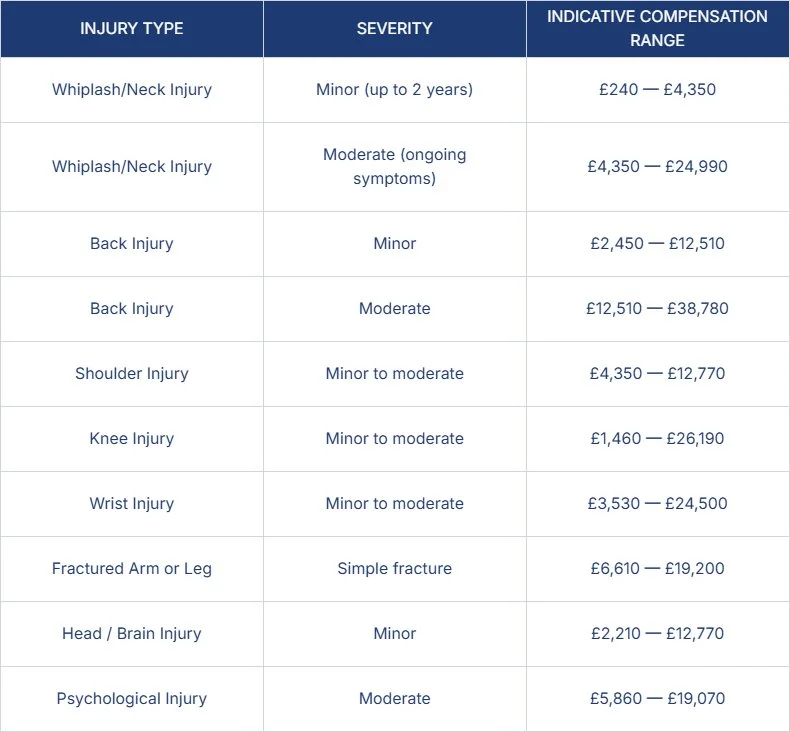
Remember: special damages are added on top of these figures. If your injury has caused you to miss work, incur medial costs, or require care, these losses are claimed separately and can significantly increase your total aware.
— HOW LONG DO YOU HAVE TO MAKE A CLAIM?
In England and Wales, the standard time limit for making a personal injury claim is three years from the date of the accident. This is set by Limitation Act 1980.
However, there are important exceptions:
— CHILDREN
The three-year limit does not begin until the child turns 18. A parent or guardian can bring a claim on behalf of a child at any point before that birthday — or the child themselves can claim until their 21st birthday.
— INDUSTRIAL DISEASE OR DELAYED DIAGNOSIS
If you did not know your injury was caused by negligence at the time, the three years runs from the date you first had knowledge — not the date of the incident.
— MENTAL INCAPACITY
Where a claimant lacks mental capacity, the time limit is suspended for as long as the incapacity continues.
— DEATH
Where a loved one has died as a result of an accident, the three-year limit runs from the date of death or the date of knowledge, whichever is later.
Do not delay. Even if you think you still have time, starting your claim sooner means evidence is fresher, witnesses are easier to trace and your recollection of events is more accurate.
— WHY CHOOSE INJURIES DIRECT
We know you have choices when it comes to personal injury solicitors. Here is what sets Injuries Direct apart:
— Personal Injury Specialists
We focus exclusively on personal injury claims. That means deeper expertise, faster handling, and better results for our clients.
— Free Initial Assessment
Your first consultation is completely free. We will tell you honestly whether you have a valid claim — even if that means advising you not to proceed.
— England & Wales Coverage
We handle personal injury claims right across England and Wales. You do not need to visit an office — we can manage your entire claim remotely.
— SRA regulated
We are authorised and regulated by the Solicitors Regulation Authority. That means you are fully protected by the SRA’S Code of Conduct throughout your claim.
— Genuinely No Win, No Fee
If your claim is unsuccessful, you pay nothing — not a penny. No hidden fees, no surprise charges. We only earn when you do.
— Plain English Throughout
No jargon. No confusing letters. We keep you informed at every stage of your claim in plain, simple English — by phone, email, or online portal.
MEET OUR PERSONAL INJURY SPECIALISTS

LEANNNE HENTON
Solicitor/Litigation Manager

LAURA MANIAK
EL/PL Solicitor



ANDREW MOORES
EL/PL Ligitation Executive
CURTIS LOCKSTON
EL/PL Litigation Executive

JOANNE SCRIVEN
EL/PL Ligitation Executive

MARK SAMMANS
EL/PL Litigation Executive

ANGELA CROSS
Solicitor
SIAN RICKWOOD
EL/PL Litigation Executive

NICOLE PARR
EL/PL Litigation Executive
— FREQUENTLY ASKED QUESTIONS ABOUT PERSONAL INJURY CLAIMS
-
The time it takes depends on the type and complexity of your claim. Straightforward road traffic accident claims can settle within 3-9 months. More complex claims — such as serious injury or disputed liability — may take 12-36 months or longer. We will give you a realistic timescale at the start of your claim.
-
The vast majority of personal injury claims settle out of court through negotiation between solicitors. Only a small proportion of claims proceed to a court hearing — and even then, many settle before the hearing date. If your case does go to court, we will give you a realistic timescale at the start of your claim.
-
Yes. If you were partly responsible, this is called contributory negligence. Your compensation will be reduced to reflect your share of the blame, but you do not lose the right to claim altogether. For example, if a court finds you were 25% responsible, your compensation is reduced by 25%.
-
Useful evidence includes: photos of the accident scene and your injuries; witness names and contact details; a copy of the accident report (if one was made); your medical records and GP notes; any correspondence with the other party; and details of your financial losses. Do not worry if you do not have all of this — we can help gather evidence as part of your claim.
-
In an accident at work claim, your employer’s Employers’ Liability insurance pays any compensation — not your employer personally. It is illegal for an employer to dismiss you or treat you unfairly because you made a workplace injury claim. You are protected by employment law throughout the process.
-
If your claim is unsuccessful, you pay nothing. If it succeeds, a success fee is deducted from your compensation — this is capped by law 25% of your general damages. We will explain the exact figure before you agree to anything. In most cases, the other side also pays a significant portion of our costs, so the deduction from your settlement is typically lower.
-
Not necessarily. The standard time limit is three years from the date of the accident. There are also exceptions for children and for injuries where symptoms appeared later. Contact us as soon as possible and we will confirm whether you are still within the time limit for your claim.
-
Yes. A parent or guardian can act as a “litigation friend” to bring a personal injury claim on behalf of a child under 18. Alternatively, the child themselves can bring a claim up until their 21st birthday (three years after turning 18). Any compensation awarded is held in trust for the child until they turn 18.