

CRIMINAL INJURY CLAIMS
Being injured as a result of a violent crime can be traumatic, distressing and life-changing. You may be dealing with physical injuries, psychological trauma, time off work, financial pressure and the emotional impact of what happened.
At Injuries Direct, a trading style of NJS Law, we help victims of violent crime understand whether they may be eligible to claim compensation through the Criminal Injuries Compensation Authority, also known as CICA.
Our aim is to make the process clear and supportive, helping you understand your options and what steps may be available to you.
WHAT ARE CRIMINAL INJURY CLAIMS?
A criminal injury claim is a claim for compensation made by someone who has been physically or psychologically injured because of a violent crime.
Unlike many personal injury claims, a CICA claim does not usually involve claiming directly against the person who injured you. Instead, eligible victims can apply through the government’s Criminal Injuries Compensation Scheme.
You may be able to claim even if the offender was not caught or convicted, provided the incident was reported to the police and the eligibility requirements are met.
CAN I MAKE A CRIMINAL INJURY CLAIM
You may be eligible to make a criminal injury claim if:
You were physically or psychologically injured because of a violent crime
The incident happened in England, Scotland or Wales
The incident was reported to the police
You cooperated with the police and CICA where required
Your injuries meet the CICA scheme requirements
You apply within the relevant time limit, unless an exception applies
CICA will also consider factors such as your conduct, cooperation and any unspent criminal convictions when deciding whether compensation should be awarded.
If you are unsure whether you are eligible, Injuries Direct can review your circumstances and explain your options clearly.
TYPES OF CRIMINAL INJURY CLAIMS WE HANDLE
HOW TO MAKE A CRIMINAL INJURY CLAIM
1
CONTACT US
Start by getting in touch with our team. We will listen to what happened, ask some straightforward questions and explain whether you may be able to make a claim.
4
2
5
SUBMIT YOUR APPLICATION
If you are eligible, an application can be submitted to CICA with the relevant details and supporting evidence.
CHECK ELIGIBILITY
We will help you understand whether your circumstances may meet the CICA scheme requirements, including police reporting, time limits, injuries and cooperation.
3
CICA REVIEWS THE CLAIM
We will help you understand whether your circumstances may meet the CICA scheme requirements, including police reporting, time limits, injuries and cooperation.
GATHER EVIDENCE
Evidence may include police reference numbers, medical records, photographs of injuries, witness details, counselling records, proof of lost earnings and any documents showing the impact the crime has had on you.
6
DECISION AND COMPENSATION
If the claim is successful, CICA may make an award based on the type and severity of injury, together with any eligible losses under the scheme.
THINK YOU HAVE A CLAIM?
No win, no fee. No upfront costs. Speak to a specialist today.
CALL 0330 818 1202
HOW MUCH COMPENSATION CAN I RECEIVE?
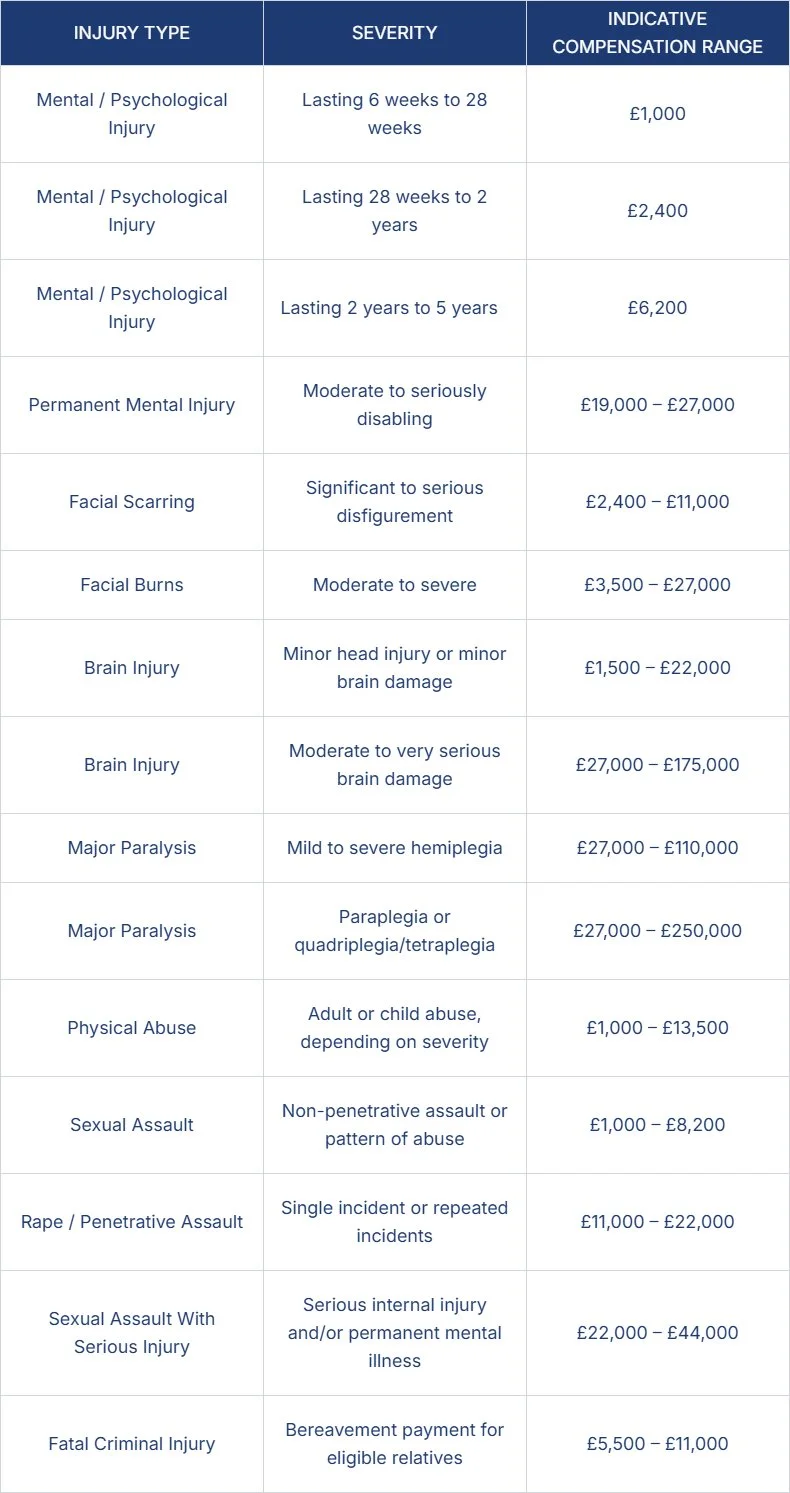
These figures are only a guide and depend on the specific injuries, evidence and CICA rules. Additional payments may also be available in some cases, including loss of earnings, special expenses, pregnancy, sexually transmitted infections, dependency payments and funeral expenses.
If you have suffered more than one injury, CICA does not usually pay the full value for every injury. Instead, it normally pays 100% of the most serious injury, 30% of the second most serious injury and 15% of the third most serious injury.
FROM ACCIDENT TO ANSWER, WE’RE HERE
WHAT IS NO WIN, NO FEE?
A No Win No Fee agreement means you can usually start your claim without paying legal fees upfront.
If your claim is unsuccessful, you normally do not pay your solicitor’s legal fees, subject to the terms of your agreement. If your claim is successful, a success fee may be deducted from your compensation.
Before your claim begins, the agreement will be explained clearly so you understand how it works and what it means for you.
HOW LONG DO YOU HAVE TO MAKE A CRIMINAL INJURY CLAIM?
CICA applications usually need to be made as soon as reasonably practicable and normally within two years of the incident.
There are exceptions in some cases, including certain child abuse claims, cases involving lack of mental capacity, or situations where there are exceptional reasons for delay.
Because time limits can be strict, it is important to seek advice as soon as possible. Injuries Direct can help you understand whether you may still be able to apply.

WHY CHOOSE INJURIES DIRECT?
At Injuries Direct, we understand that making a criminal injury claim can feel difficult, especially after a traumatic experience. We provide clear, supportive guidance and explain the process in plain English, so you know what to expect.
We take the time to understand what happened, how you have been affected and what evidence may be needed to support your claim. From your first enquiry through to the outcome of your application, we aim to keep you informed and supported.
Injuries Direct is a trading style of NJS Law, giving clients access to professional legal support and guidance.
OUR CICA SOLICITORS

NAFISA MASTER
CICA Litigation Executive

DAVID SENIOR
Litigation Executive

CURTIS LOCKSTON
Litigation Executive
-
CICA stands for the Criminal Injuries Compensation Authority. It is the body responsible for handling compensation claims from eligible victims of violent crime.
-
Yes, you may still be able to claim even if the offender was not caught or convicted, as long as the incident was reported to the police and the scheme requirements are met.
-
Yes. CICA usually requires the incident to have been reported to the police. You may also need to cooperate with the police investigation.
-
Yes, psychological injury may be included if it meets the CICA scheme requirements and is supported by evidence.
-
Yes, victims of domestic abuse may be able to claim compensation for physical or psychological injuries caused by violence or abuse.
-
In some cases, yes. Different rules may apply depending on when the abuse happened, when it was reported and the reasons for any delay.
-
The time can vary depending on the complexity of the case, the evidence required and how quickly information is received from the police or medical professionals.
-
CICA claims are usually handled through an application process and do not normally require you to go to court.
-
CICA may take criminal convictions into account and this could affect whether compensation is awarded or the amount received.
-
Many criminal injury claims can be handled on a No Win No Fee basis. The terms will be explained clearly before your claim begins.