
WHAT DOES NO WIN, NO FEE ACTUALLY MEAN?

Almost every personal injury firm in the country advertises no win, no fee. Far fewer explain what actually comes out of your compensation at the end, or what would happen if the claim were lost. That gap is where most of the unpleasant surprises live.
This guide sets out the whole arrangement in plain English: what you pay, what you do not pay, who pays what if you lose, and the questions worth asking any solicitor before you sign anything.
WANT IT EXPLAINED PROPERLY BEFORE YOU COMMIT?
0330 818 1202 · injuriesdirect@njslaw.co.uk
— WHAT IS A CONDITIONAL FEE AGREEMENT?
A Conditional Fee Agreement, or CFA, is a written contract between you and your solicitor. It says that your solicitor's fees are conditional on the outcome of your claim. CFAs were introduced by the Courts and Legal Services Act 1990 and reformed by the Legal Aid, Sentencing and Punishment of Offenders Act 2012 (LASPO).
In practice it works like this:
Your solicitor does the work and records their time as normal.
If the claim fails, you pay them nothing for that work.
If the claim succeeds, the losing party's insurer pays the bulk of your solicitor's costs, and a success fee is deducted from your damages.
Your solicitor is taking a commercial risk on your case. That is why they will be honest with you about its prospects — a firm that takes on hopeless claims does not stay in business.
— WHAT IS A SUCCESS FEE, AND HOW MUCH IS IT?
A success fee is an uplift on your solicitor's normal charges, which compensates them for the risk of running cases that do not succeed. Since April 2013 it is no longer recoverable from the losing side, so it comes out of your compensation instead.
In personal injury claims the success fee is capped by law at 25% of:
your general damages (for pain, suffering and loss of amenity), and
your past financial losses (earnings and expenses already incurred)
Critically, the cap excludes damages awarded for future losses. In serious injury claims, where future care and lost earnings can be by far the largest element of the award, this protects the money you will need for the rest of your life.
25% is a statutory maximum, not a standard rate. Firms may charge less. Always ask what the actual percentage is.
WHAT WILL HAPPEN IF YOUR CLAIM DOESN’T SUCCEED?
Your own solicitor's fees: Under a properly written CFA, you pay nothing for your solicitor's time and work if the claim is unsuccessful.
The other side's costs: This is the part people do not think about. In litigation, the losing party is normally ordered to pay the winning party's legal costs. In personal injury claims, a protection called Qualified One-Way Costs Shifting (QOCS) applies.
QOCS is set out in Part 44 of the Civil Procedure Rules. It means that in most personal injury claims, an unsuccessful claimant cannot normally be made to pay the defendant's costs, even though they lost.
The protection is qualified, not absolute. It can be lost where, for example:
the claim is found to be fundamentally dishonest
the claim is struck out as an abuse of process or for disclosing no reasonable cause of action
costs orders are made in the defendant's favour and can be enforced against your damages and certain costs recovered in the claim — the rules on this were tightened from 6 April 2023
you fail to beat a defendant's Part 36 offer at trial
That last point matters. If the other side makes a formal Part 36 offer and you reject it, then a judge later awards you the same or less, you can become liable for the defendant's costs from the date the offer expired. This is why advice on whether to accept an offer is one of the most important things your solicitor does.
WHAT IS QOCS?

— DO I NEED INSURANCE?
Often, yes. After the Event (ATE) insurance covers the risks that QOCS does not, including:
the other side's costs in the circumstances where QOCS protection is lost
disbursements — the expenses paid out during the claim, such as medical expert fees, court fees and records charges
An ATE premium is normally deferred and self-insuring, meaning you pay it only if you win, and it is usually paid out of your compensation.
Before arranging ATE, your solicitor should check whether you already have Legal Expenses Insurance. Many home, motor and travel policies include it, and some trade union memberships and bank accounts do too. If you already have cover, ATE may be unnecessary. It is worth digging out your policy documents before your first call.
NO UPFRONT COSTS · NO HIDDEN CHARGES
— WHAT WILL ACTUALLY BE DEDUCTED FROM MY COMPENSATION?
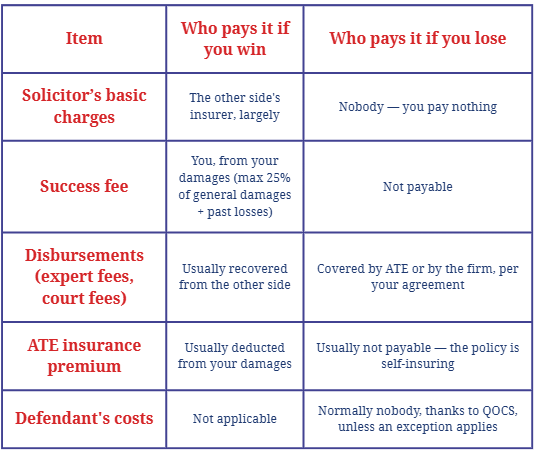
— QUESTIONS TO ASK BEFORE YOU SIGN ANY NO WIN, NO FEE AGREEMENT
Whoever you instruct, ask these. The answers should be given clearly and in writing.
What is the maximum total deduction from my compensation, expressed as a percentage?
What is the success fee percentage, and what is it charged on?
What is the success fee percentage, and what is it charged on?
Have you checked whether I already have legal expenses insurance?
What happens if I decide to stop the claim partway through?
Who pays the disbursements as the case goes along?
What happens if I reject an offer you advise me to accept?
Are you a firm of solicitors regulated by the SRA, or a claims management company?
That last question matters more than people realise. A claims management company is not a law firm, does not act for you as your solicitor, and will pass your case to a panel firm. Injuries Direct is a trading name of NJS Law Limited, a firm of solicitors authorised and regulated by the Solicitors Regulation Authority (SRA number 8006550).
CAN I CHANGE SOLICITORS PARTWAY THROUGH?
Yes. It is your claim and you are entitled to instruct someone else. Be aware that your original firm may be entitled to be paid for the work they have already done, depending on the terms of your agreement and the reason for the change. Speak to a new firm about the position before you make the switch — they will need to review your existing CFA.
FREE CONSULTATION. NO OBLIGATION. NO UPFRONT COSTS.
— FREQUENTLY ASKED QUESTIONS
-
It means you pay your solicitor nothing upfront and nothing for their work if your claim is unsuccessful. If you win, most of their costs are recovered from the other side and a success fee is deducted from your compensation.
-
For your own solicitor's fees, yes. The separate risk is the other side's costs, and in most personal injury claims Qualified One-Way Costs Shifting means you would not have to pay those. ATE insurance covers the situations where that protection does not apply.
-
In personal injury claims it is capped by law at 25% of your general damages and past financial losses. It cannot be taken from damages awarded for future losses. Firms may charge less than the cap, so always ask.
-
No. Under a no win, no fee agreement there is nothing to pay when you start your claim.
-
It is the formal name for a no win, no fee agreement — a written contract making your solicitor's fees conditional on the outcome of the claim.
-
Qualified One-Way Costs Shifting. It is a rule in the Civil Procedure Rules that generally prevents an unsuccessful personal injury claimant being ordered to pay the defendant's legal costs. It can be lost in certain circumstances, including a finding of fundamental dishonesty.
-
After the Event insurance covers the costs risks that remain despite QOCS, such as disbursements and the defendant's costs in exceptional cases. Whether you need it depends on your case and on whether you already have legal expenses insurance.
-
Quite possibly. Many home, motor and travel insurance policies include it, as do some union memberships and packaged bank accounts. Check your documents — it can remove the need for a separate ATE premium.
-
Often, yes. Partial fault reduces compensation by a percentage rather than preventing a claim, and many such claims are still viable on a no win, no fee basis. We will tell you honestly if we do not think yours is.